. brightmeadowknits

Saturday, January 15, 2022

Finally....learning how to crochet

 I never thought I would ever learn how to crochet. It's like a mental block for me. Every time I open up a pattern and look at the instructions for half double, treble, single, or double crochet stitches all together in one row, I freeze. I can't seem to remember why a single crochet is NOT THE SAME as a half double crochet. And then when it starts talking about making shells? No way.  

Last year I started making a big hamper, though, using worsted weight yarn. It's only one stitch pattern. A single crochet. Over and over. I must have made ten thousand stitches by now. It's a good mindless project to do while watching TV with my husband. I started without a pattern, and, as was probably to be expected, it's pretty floppy. My vision was to have a big hamper or basket to pile afghans in. I'm not sure if I'll ever get done with it. I still have to work out how to make handles. But my main goal was to learn the single crochet stitch, and I have succeeded in that.


And (drum roll, please....) today I learned to do a half double crochet stitch!


This scarf is only made up of foundation and turning chains and the half double crochet stitch.  I think this is the best way for me to learn, by reposition, until muscle memory takes over and I have learned the stitch. 

I got a full row about six feet long done in the class, and I have gotten a little faster and done a few more rows since I got home. The yarn is a bulky weight and I am using a size 6 (European?) hook. The pattern actually called for a larger hook.  

Actually, the pattern called for a size N, but I thought we were supposed to use a size K, which I do not have in my collection. 


 Isn't it nuts for someone who doesn't know how to crochet to have so many crochet hooks?  I've acquired many of them along with sets of second-hand knitting needles.

Maybe in 2023 I'll attempt the double crochet stitch!

I had not visited Alpaca Meadows before.   Right now their hours are limited to Saturday afternoons, and other days by appointment.   I was amazed at the beautiful variety of alpaca yarns, accessories and alpaca-themed gifts they had in stock.   I'll definitely be back.  Even after the second half of the class which is in two weeks.


I had no idea we had this resource in our community.  So even though we don't have a LYS on Main Street any more, between Alpaca Meadows and the Fiber Arts Guild at Malabar Farms where handspinners sometimes offer beautiful handspun yarn, a knitter will never be out of yarn here.


Wednesday, January 12, 2022

Biking, touring, and Knitting?

Are you a knitter? Are you an easygoing touring cyclist willing to pedal from 30-50 miles a day, camp in a tent sometimes, and sleep in a bed-and-breakfast other times? 

I'm planning a two-week tour of Ohio and Indiana local knitting shops, alpaca farms, and sheep farms as well as other fiber-y places.  I also anticipate stopping at locally-owned restaurants for lunch and dinner, as well as local bike shops for necessities.  


I'm still working out the details.  I know I won't be taking along a knitting machine or a spinning wheel, but maybe a pair of needles would fit in my pannier.  I anticipate buying some yarn along the way, and I am assuming they will ship it to me! 

This trip was inspired by Knit 1, Bike 1, a book by Janet Renouf-Miller, the story of a "woman of a certain age" who cycled across Scotland visiting local knit shops.  Along the way, she crocheted some of the things she saw, she kept her fans updated, and she made a voyage of self-discovery. 

I, too, have been discovering what I can do now that I have retired.  I never thought of myself as an athlete, but over the course of the last two years I have pushed myself to ride further than I ever thought possible.  All it took was the BELIEF that I could do it.  

I am looking at dates for this tour.  Someone suggested I should leave from the Great Lakes Fiber Expo in Wooster Ohio over the Memorial Day weekend.  That might get me back just in time to leave for the Pedal Across Lower Michigan in late June.  

I think I am maybe not the only one who would like to do this.  I just read an article in Adventure Cycling from 2012 where a whole knitting club took a bike trip to the Cour d 'Alenes in Idaho. 


Saturday, January 1, 2022

Adventures in Sock Yarn

 I don't remember if I posted about the "free" yarn I got on Craiglist, several years ago.  My daughter called me and told me that I should check it out.  The listing said, "we just moved in, there is something in the barn, we think it might be wool, if you want it you can have it."  So I went and picked it up with my husband's truck. It was, indeed, sheep's wool.  I took it home and unloaded it.  Unrolled the sheets and looked at it.  It looked like a lot of work.  The fleeces needed to be unrolled, skirted, picked, washed, carded, and spun in order to get some yarn out of it. 

I thought about how I would accomplish all that work for a few weeks.  Then I drove to Michigan to the Zeilinger Woolen Mill and inquired if they would be able to process it.  It turned out that I had just enough wool to meet their minimum quantity for processing, and they would be happy to perform all those services for me.  

So, I had them make some sock yarn and some DK yarn, and leave some at the roving stage for me to spin. I don't remember the exact number of cones I received.  It was either about 50 of each, or 100 of each.  Probably 50. 


The yarn feels a little rough on the cone, but once it is knitted and washed, it is delightfully soft and fluffy.  I spoke with a fiber person in Michigan later, and she mentioned that she did not like the smell of the spinning oil that Zeilinger's uses.  I hadn't noticed it previously, but now I do.  It does wash out and is not noticeable in the finished garment. 

I've moved these cones from Ohio to Michigan and back, and I recently decided it was time to use some of it.  I have previously dyed some of the DK yarn for sweaters,although I haven't knitted the sweaters yet,  and I have made four pairs of socks from the sock yarn.   I love the socks, but I have way more sock yarn than I will be able to use up on socks.  So I decided to knit a sweater with the sock yarn, 

The yarn is a little bit heavier than  commercial sock yarn. It does go through my circular sock machine well, but I wasn't sure how the flat-bed knitting machines would handle it.  So I started swatching.  I know that being plus-sized, it would be to my advantage to get the widest possible fabric for the number of needles, so I picked a built-in tuck stitch to swatch.  I ended up choosing stitch pattern 229. 

I swatched in stockinette, in tuck, then I used a variation that Mary Ann Oger had mentioned in the last seminar I attended with her. This is to turn on the double-high key and tuck in only one direction.  The technique produces a flatter fabric with a less bulky tuck design. She says it looks less like a baby blanket that way. 

My first swatch was on a KH-930 standard gauge at tension 8.  I cast on a few stitches on either side of 21 and marked the tension with 8 eyelets.  Then knitted a couple of rows of contrasting yarn (I used acrylic because I have a lot of it.)  It was super hard pushing the carriage across the bed.  The resulting swatch seems a little stiff.  But I was surprised that the stitch tension swatch with only every other row tucked was almost as wide as the tuck sample! 


I washed the swatch in warm soapy water and wet-blocked it.  After it was dry, I removed it and I knew I would not like a sweater at this gauge. 

Since that tension was so tight, I thought that perhaps the yarn would do better on a bulky machine. I tried the bulky KX-260 punchcard machine.  I set the machine for tension 1. I cast on a 20x30 swatch with a few stitches on either side.  The yarn fed easily through the machine, but the resulting fabric seemed a little bit lightweight.  Just for comparison, I went ahead and continued to make another swatch at tension 2.  I was worried about how I would achieve a ribbing at a tighter tension on this machine, since the stitch size tension was already at 1 and 2, and not possible to set any lower.  I didn't think this fabric would work, so I didn't bother digging out a tuck punchcard.   I went ahead and washed and blocked the swatches anyway.  

Meanwhile, I decided to have another attempt on the KH-930 standard gauge machine.  I still had tension 9 and 10 as a possibility.  I did make stockinette, tuck, and half-tuck in each stitch size for this swatch.  You might note that I carry my marker yarn up several rows.  This helps me with keeping the stitches aligned while blocking. I'm not all that excited about the half-tuck pattern.  I am thinking I may just make this sweater in stockinette.  A simple, classic V-neck sweater. 


Final swatch was on the mid-gauge KX-350.  I decided to only do stockinette, since the KX-350 does not have built-in patterning.  My KX-350 is in rough shape.  The last time I used it on worsted-weight yarn I really had a hard time pushing the carriage across.  I turned the carriage over and I saw a lot of gouges in the plastic guides.  So I filed them down a little using sharp scissors and an emory board, lubed the machine, then proceeded to make my swatches.   I used tensions 1 through 4.  I hand-latched up the ribbing.  After washing and blocking this swatch, I like the "hand" of tensions 1 and 2.  I like tension 1 best. 


The carriage pushed a lot easier than the KH-930.  


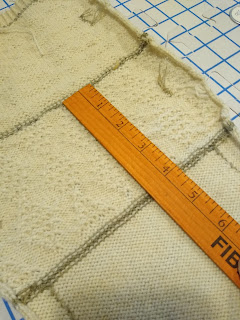
Next, I measured the height and width of each of the swatches, between the marking threads.  


I entered all these measurements in a spreadsheet.  Listen to my comments by clicking the arrow in the display below.


I'm also hand-knitting a cowl with some yarn I acquired a few years ago at Heritage Spinning and Weaving in their clearance sale.  The yarn is mostly silk.  It's from "Delicious yarn"  and the pattern is "Gourmet Cowl"  The yarn is so soft, it is like a cloud.  There are pictures of it on their Facebook page, and you can also find it on Ravelry or Etsy.  You can google for "Delicious yarn gourmet cowl images" to see it.  Unfortunately I can't post a photo directly unless I take my own photo, and my cowl is only a few inches tall at this point!   It is definitely a project for a yarn snob as this yarn is just luscious! 


 It has been a frustrating pattern for me to knit, because I started knitting on a car trip.  I missed an instruction to knit one stitch on the first few rounds, so my rounds were not coming out right.  I think after about row 10 I finally got it right.  The cowl is knit on circular needles, but after each row there is a wrap and turn, so it is actually knit back and forth, but in a circle. I loved the look of the cowl, and I love the yarn.  I am just finding hand-knitting it too slow.  I don't mind hand-knitting on a car trip, but I don't like it at home with all these machines available. 

My brain is on fire with ideas about how I could knit this pattern on the machine.  I attempted it on my bulky with two acrylic yarns.   It isn't happening.  It would require the intarsia carriage plus the ribber, and I don't think they are compatible.  Then this morning, I got a brainstorm.  What if I turned it 90 degrees?  I could use the garter bar to flip the fabric every so many rows, and knit it on the diagonal.  I abandoned my half-started sweater on the 930, and picked some fuzzy acrylic yarn in my stash to see if I can make it work.   Instead of switching from knit to purl every 8 rows, I am doing it every 20 rows.  I will write the pattern up once I get it completed.  If it turns out!  It will not be identical, it will be similar. 


I just received two used machines (which is why we took the long car trip.)  I will be checking them out to see if all the parts are there and what kind of condition they are in, then will use them either for lessons or for sale.   I had been bidding on some auction machines and lost the bidding war, so when these two became available I jumped on the chance!  

My dear husband is currently trying to repair my KH-970.  The control box is not working.  It would appear to work until I plugged the control box into the knitting machine.  Then it would start a rapid ticking noise (my husband says it is "motorboating", for the technical term.) and the coffee cup would display.  After a time, the menu would come up.  I tried to load a pattern and knit, but the needles were not selected properly, and then the motorboating started again.  On the Facebook 970 group, someone mentioned to replace the battery.  Since the backlight for the LCD display has not worked for many  Checking the parts catalog I found that the replacement battery was a Lithium CR-2032, a common 3-volt coin cell battery. 

When I opened it and replaced the battery and the backlight, closed it back up, the symptoms did not improve.  However, the backlight was working again.  My husband has taken this as a challenge.  We got out his digital multimeter and ran through the tests in the service manual that were possible to perform. Everything was supposedly working.  He suspects it is a cold solder joint that needs to be re-soldered.  He started doing this last night and blew the fuse on the board.  We ordered a replacement fuse.  A few minutes later he blew the fuse in the transformer.  So until we find a replacement transformer (Power supply) we will not be experimenting any more.  There is always the option of spending $600 to purchase a CB-2 from the Knit Knack shop. But as long as I have more than 5 working machines, I am questioning why I would want to do that. 


Tuesday, July 20, 2021

Monicello, Illinois - Crankers of Wonderful Socks 2021 report

 I just returned from the COWS seminar in Monicello.  I was so happy to see my friends Julie and Dorinda from Michigan again!  


I made a few new friends also.  This is Jan, and the back of her sister's head.  I sat across from a lovely woman named JoAnne who teaches at a local yarn shop in Noblesville, Indiana.


I observed this abbreviated pattern posted on a yarn mast. Short and sweet!


There were a few men in attendance, including one who brought his spinning wheel. 


Here is a skein of Kroy sock yarn on my bobbin, ready to knit. 


I took a photo of the yarn label, resting on the door prize I won, a tool caddy.  It is a wooden disk with a hole in the center, made to fit on top of a bobbin. 


Here is another take on a visual pattern.  I may adapt this one for my use. 


The room was pretty packed with crankers. 


There were a lot of variations on tool chests and caddies.  Dorinda suggested I adapt my Auto Knitter wooden box that I use to tote yarn and tools to put a lid on it, with a hinge, to make something like a gateleg table, or sewing table extension,  so that I have more surface area to work with. 


I made a pair of matching socks using my sock yarn, spun by Zeilingers from my "free" Craigslist wool.    It is a little heavy for the 72-cylinder, but that is the only cylinder I have for my Master Machine Home Profit. 


This is the cone of my yarn on the bobbin, waiting to be knit. 


And Jan took a photo of me.  That is Julie, Dorinda, and JoAnne in the background. 


I took two classes, both from Jenny Deeters.  The first was on tension and measuring your socks so that you can make them to fit all sizes of feet.  The second was knitting a lace cover, including sparkling Crystalettes, for a  4-inch glass or plastic Christmas tree ornament.  The Crystallettes are available from Jamie Mayfield or from Yadasi Beads.  

There were many more classes available, but I wanted to concentrate on making friends with my machine again.  I have not used it for two years prior to the seminar, since we moved from Michigan.  My pattern is not written down, (at least not in a portable form) and I was trying to do it from memory.  The pattern aids I saw on other's machines will help me. I made three good socks, 1 mistake sock, and a tension swatch. 

The hotel was doing a great job dealing with soooo many guests (I think it was full every night) while still coming out of COVID-19 restrictions.  

I had a great time, thanks to the meeting hosts Peg Wileaver and  Pat Lane.  I managed to come home with less than 10 new skeins of yarn, and I left some there.   

I also got to take some fabulous bike rides around Monticello.  See my blog on bicycles http://brightmeadowbicycle.blogspot.com for more info. 

Wednesday, May 5, 2021

The Seville Shawl

 I've been exploring Seville, Spain virtually recently. You can find related posts on my blogs for bicycling and kitchen gardening.  I visited Seville in the spring of 1977 for Semana Santa (Holy Week) during my junior year of college.  It was a whirlwind tour through Toledo, Granada, Seville and Valencia, and I am sure my friend and touring partner and I didn't see even one hundredth of the sights we should have seen.  

My memories of Seville are the quintessential images of Spain.  Flamenco dancers, whitewashed villages with trailing flowering vines, colorful geometric tiled walls, narrow streets with ironwork balconies, and orange blossoms.   


The shawl is dramatic in the photo above.  Mantoncillos are woven shawls with fringed edgings that are typically embroidered with flowers. Mantones are the lace shawls that women wear on their heads for weddings, bullfights, and funerals, which are typically worn with a peineta (comb) for the full effect.  


These shawls are somewhat more formal. Knitted and crocheted shawls seem to be a little less formal, although they can still have dramatic fringe. 


Fourty-five years later, I set out to find out what is going on in the knitting world in Seville.  La Merceria (lamerceria.com) shows a few free patterns on its web site.  

An online-only shop for yarns is Lana y Telar.  In a residential neighborhood, fellow blogger Chain Twenty posted about her visit to the dye works.  

Devanalana is a Sevillana knit designer and blogger.  Her blog is in Spanish, but using google translate, I was able to understand that she is interested in ethical fashion.  She offers knitting classes.  

There are 14 patterns with "Seville" in the name in Ravelry, ranging from a macrame wall hanging to a shawl to a bolero to a cabled sweater.  The one that most embodied the feeling of Seville for me is the one featured on the cover of Simply Knitting September 2010 with its lace borders.  And, as a plus-sized person, I was grateful for the large size range.  


I also found numerous patterns containing "Sevilla" in the name or description, and I especially like this shawl pattern incorporating various types of lace.  However, I would want to rewrite the pattern to allow it to be knitted on the knitting machine, as I would be driven crazy trying to handknit such a large piece.  


Sunday, February 28, 2021

Slider Lace Poncho and other projects

 Diana Sullivan Facebook Seminar

I am attending a virtual seminar with Diana Sullivan on Facebook over the course of the next two weeks.  She sent the materials list in plenty of time with instructions to be ready for the seminar.  Knowing I've got thousands of cones of yarn available, I procrastinated on choosing my yarns till the seminar began.  

The first session was for two projects, a Slider Lace poncho, and mukluks.  I cast about for a suitable yarn and found a random beige cone which I think is cotton, and decided to spice it up with a lace-weight skein that has been calling to me every time I walk past saying "knit me, knit me"!  The lace weight is by Premier Yarns and it is wool-free Lace.  The color is Limestone Glow.  It was in my sock yarn basket, so I assumed there were two skeins. 

The two yarns complement each other very nicely. I knit a gauge swatch and found that the "slider" in the stitch pattern tended to slide a lot with these smooth yarns, losing the definition.  Diana had warned us that this could happen, but she also encouraged us to use our stash yarns.  Her yarn choice was "shawl in a ball", which I've used before.  It has a "hairy" texture.  The original technique was to leave two needles out of work between each vertical column of stitches, and move edge stitches from one column to the next.  Here's my swatch. 


I decided to modify the stitch pattern.  Instead of just moving the stitch to an empty needle, I "pegged" it to another stitch by hanging it on the needle that already had a stitch on it.  I knit a row, then "made" a stitch by lifting the top loop from the butt of the adjacent stitch.  

Slider 2 lace with anchored stitches. 

I am pleased with this stitch.  The poncho should not take too long to make, as it is two rectangles.  Unfortunately,  now that I am half done with the current rectangle, I realized I cannot find the second ball of Premier Wool-Free Lace that I thought I had in my sock yarn basket.  Did I only buy one? It's possible.  I have begun a search for another skein of this yarn.  My first place to look was on Ravelry.  They have a feature where people can enter their stash and indicate whether it is for sale or not.  I did find several people who have this yarn stashed.  I sent off messages to them, in case they are willing to part with their stash,  but to date I have not heard back from anyone.   I also did a google search, and found a listing for WalMart.  Unfortunately, no stock.  Same with Mary Maxim, Herschnerr's, Yarn Barn, JoAnn Fabrics, Michael's, Hobby Lobby, and a bunch of other yarn stores.  I looked on ebay and Etsy.  I looked on Craiglist.  I looked at Letgo, only to find out it has been acquired by another company.   

In the process, I discovered a few sources that had the same yarn but in different colors.  I ordered three skeins of lavender-colored yarn.   If all else fails, my poncho will be color-blocked, or I may decide to frog what I have done and re-knit a solid color, use this yarn for something else.   

Bicycling in the Mountains Hats

In the meantime, I have completed my etsy orders for hats.  This one was inspired by another Ravelry user, but I used my own hat shape and her stitch pattern. 

This hat used a 20 percent angora, 80 percent acrylic.  I love this yarn!  It is so soft.  And I really like the color.  I have it in sky blue, teal, and this raspberry.  I don't think it is produced any more.  I am thinking of making a sweater for myself with this yarn down the road. 

  I am working on the pattern for this one, which I plan to release on Ravelry and Etsy. It uses the same shape file as the other one, which is my own design.  It is very simple design, so if anyone else has already made a hat in this way, my apologies, but I did design it.   My pattern will include four colorways, one for each season.  This version will be "summer".   

I was asked to knit a sweater in this pattern.  There are a lot of possibilities.  I did a few designs in Designaknit, with a bottom border, a top border, an all-over pattern, and also gave the person a photo of a similar round-yoke sweater.   I worked up some pricing.   We'll see if anything comes of the request.  


Setersdal Sweater

This week I photographed some punchcards from Rowan's book of designer machine knits for the Setersdal pattern.  I knitted this sweater long ago on a punchcard machine,  in Yeoman Yarn 50-50, a blend of 50 percent acrylic and 50 percent wool.  This yarn DOES shrink.  Especially if it gets washed with a bunch of jeans in the washing machine and dryer.   And because I made it a cardigan, with a zipper, the zipper buckled.  So although the design makes me happy, I cannot wear the sweater, at least in public.  I really should just take out the zipper for recycling and throw the sweater away or use it for a dustrag.   

This time I intend to knit it in a  Wool-rayon blend I purchased from Made In America yarns.  The design is classic and timeless.  Here's a link to a photo published in Ravelry.  Setersdal Sweater 

I was able to successfully use the graphics import feature in Design-a-Knit to import these photos into stitch designs.  I had to do a little touch-up editing.  Because my photos were not 100% flat, I had to use the checkbox to "move corners independently" to capture the dots.  I corrected the third punchcard, which I believe is missing a dot in rows 1 and 2, the XO row of the design.  My original sweater also had this mistake, because I was faithful to the punchcard as given in the book.    If you look carefully at the photo from the book (shown in the Ravelry picture) it appears that possibly these stitches were duplicate stitched after the fact.      But I have them now!  These stitch designs may be useful to incorporate into other designs sometime in the future. 


Translating hand-knitting to machine

My final project this week was to pick up a request from a few months ago to translate a hand-knit pattern for a child's bunny toy to machine knitting.  My initial reaction, when I was asked and saw the hand-knit pattern, was that it would not be very good pattern for machine knitting.  The reason is that there were increases on almost every row in the middle of the row.  The client asked to proceed anyway.  

I picked it up and realized there was no way to get that many increases (for the head) on the machine.  There wasn't enough yarn to stretch between the needles.  So I turned the head around, cast on with waste yarn and open stitches, and knitted it using decreases.  Then I re-hung it on the needles and proceeded to the back.  Again, there were both increases and decreases in the middle of the row.  I attempted using the garter bar,  but because of the way the increases were mirrored on each side of the rabbit's back, it was quite awkward.  I tried to use a lace tool I had inherited, which is similar to a transfer tool, to move twenty stitches at a time.  Unfortunately the quality of the tool was bad (or perhaps it was a slightly different gauge?), the prongs to transfer stitches did not line up with the needles of my machine.  So that was out.  I tried using the 7-stitch transfer tool, but this required multiple moves within the row.  I looked ahead and found that the upper thighs of the bunny required short rowing on each side of the body.  It could be done, but since it only used a few body stitches, I thought perhaps it would be easier to take the body off on waste yarn and rehang, using a sew-as-you-go technique. 

Then I took a deep breath.  The body of this rabbit was only about 70 stitches wide.  It would be so easy to knit it by hand.  And so hard to knit it by machine. And frustrating! 

I messaged the client and told her it was not going to be a fun knit, and I really did not recommend going forward.  She accepted my advice!  So I'm off the hook.  Yay! 
© Bright Meadow Knits Blog · Privacy Policy · Terms of Use
© Bright Meadow Bicycle Blog · Privacy Policy · Terms of Use