1589 - In England, William Lee develops a knitting frame, generally credited as the first knitting machine. It used barbed or spring needles. (A Short History of Machine Knitting)
Photo credit - Calverton Village
1816- Marc Brunel, a French engineer, built a machine in the UK in 1816 that arranged the needles in a circular form rather than a flat bed. It was oriented horizontally. (A Short History of Machine Knitting)
A photo of Brunel's design is available on the Science and Society Picture Library page.
In the early 19th century clothing was still handmade, produced for the family by women in the household or custom-made for the more well-to-do by tailors and seamstresses. The first production of ready-to-wear garments was stimulated by the needs of sailors, slaves, and miners. Although still hand-produced, this early ready-to-wear industry laid the foundations for the vast expansion and mechanization of the industry. (Case Western Reserve website)
1830's - Villages of Leesville and Middletown established along the first state highway running between Cleveland and Columbus. (History of Crawford County Page 645)
In about 1835, a number of German families came into the (Jefferson) township (of Crawford County, Ohio), many from Pennsylvania, and a number from the Fatherland, and at present (when the history was written) a considerable portion of the population is German. (History of Crawford County Heritage Pursuit)
1839 - Abner Doubleday is credited with inventing baseball in Cooperstown, New York.
1839 - "A mechanic and a capitalist" are working on the problem of a knitting machine. They visited the workshop of Ari Davis in Boston. Davis told them to go invent a sewing machine instead. Elias Howe was a young man working in the shop and overheard this conversation. He later went on to develop a sewing machine. (James Parton in History of the Sewing Machine,)
1840 - Wedding of Victoria and Albert in England. There is an extensive exhibit of knitting machines in the Victoria and Albert museum in London.
1843- William Franz born in Leesville, Ohio. He was the son of John Franz, the former Crawford County Sherriff and later Treasurer, who was a Civil war veteran and who had been born in Baden, Germany. (Biddy Pope obituary, also Myra Franz Obiturary). William subsequently attended school in Bucyrus. He studied and apprenticed(?) in Plymouth, Cleveland, and Meadville, PA.
1845- Peter Claussen from Belgium developed Brunel's idea and patented an improved circular machine in 1845. It could produce a substantial tube of knitted fabric for cutting and be powered by hand or steam.
1848. Amelia Bloomer went to the Seneca Falls Women’s Rights Convention. (Norwood, Arlisha. "Amelia Bloomer." National Women's History Museum. 2017.)
1849 - Matthew Leo Townsend from Cropston, Leicester,1 UK, the son of a framework knitter, patented a latch needle in 1849. The latch needle is much more versatile than the spring needles, and does not need to be placed horizontally, as the latch itself does much of the work. (A Short History of Machine Knitting)
1850, Crestline - First came the railroad, and then came the town. It all started in 1850 when a route was needed between Shelby and Galion, a distance of 13 miles, by the Cleveland, Columbus and Cincinnati railroad, or the “Bee Line” as it was known then. The Crestline area, however, wasn’t the first choice by railroad officials for the line – Bucyrus was. However, the leading officials of Bucyrus were interested in a wagon road from Sandusky to Columbus.
The next choice was Mansfield, but the citizens there had recently financed a road to Newark and were not interested in funding a railroad. The next choice was Leesville, but the residents there were afraid the railroad would take business from many of the citizens there who made livings hauling stone for the Leesville Stone Quarry. This left the railroad with no choice but to run the line through open country.
Since there was no town between Shelby and Galion, it was decided that a station should be placed halfway for passenger convenience. The station was constructed where the line crossed the Leesville road.
This station soon developed into a town, with a general store, post office, and a few homes. Early settlers in the village believed that the town was the watershed of the state, where streams to the north emptied into Lake Erie and those to the south emptied into the Ohio River, thus the name Crest Line. The town was not on the watershed line, but the name stuck and eventually became one word.
(History, Village of Crestline)
1852 Theodor Groz opened a store for toys and fashion accessories with an attached needle workshop in Ebingen, Germany, today part of Albstadt. In the same year he produced needles for warp knitting and hosiery production for the first time.
On July 8, 1853, American Commodore Matthew Perry led his four ships into the harbor at Tokyo Bay, seeking to re-establish for the first time in over 200 years regular trade and discourse between Japan and the western world. (US State Department)
The Pennsylvania Railroad's charter was supplemented on March 23, 1853, to allow it to purchase stock and guarantee bonds of railroads in other states, up to a percentage of its capital stock. Several lines were then aided by the Pennsy in hopes to secure additional traffic. By the end of 1854, the Pennsy purchased stock in the Ohio & Pennsylvania, Ohio & Indiana, Marietta & Cincinnati, Maysville & Big Sandy, and Springfield, Mt. Vernon & Pittsburgh railroads, totalling $1,450,000 (equivalent to $43.7 million in 2021).
1855. Dr. William Pope, age 30, arrives in Crestline from Western New York, setting up practice as a physician and attending to many illnesses and injuries. He invested in oil wells in Crawford County prior to joining William Franz in the jewelry business. (Obituary in Bucyrus Evening Telegraph, Sept. 3, 1890)
1857. Reciprocating circular cylinder knitting machines developed (YouTube - Garment Manufacturing)
1860's - Family of Almira Campbell, a seamstress, according to a post on Rootsweb, moves from Pennsylvania to Ohio. This may have included her grandfather Connileas Stantley who was born in Ireland and may have lived in or near Uppingham, Rutland, England before immigrating to US, where knitting machines were in high degree of utilization.
1861 St. Joseph Catholic Church. The first church was erected on the corner of North Street and Bauer Court. The first Resident Pastor was father Puetz. In 1868 the first school was built onto the back of the church. Due to the need for a larger church, a second church was started in the late 1880's and was completed in 1892.
(Bowling Green State University archives)
1861 - Walter Aiken introduces his family circular knitting machine with patterns for stockings which required sewing up.
1861-1865 The circular machine had a great boost during the time of the American Civil War, when the quartermaster general of the Northern army decided the quality of its socks and stockings was far better than the frame knits with necessary seams he had been offered. (A Short History of Machine Knitting)
1861- Socks and Stockings, Shirts, Drawers, and Sashes – EAIA (eaiainfo.org) reports much detail about socks during the civil war, discusses the sewn socks produced by Aiken knitting machines. In addition, "George “Johnson,” who in 1861 contracted for 25,000 pair of army socks, was likely George Johnstone, a Germantown, Pa., woolen hosiery manufacturer. By 1870 he patented two improvements in circular knitting machinery which may have resulted from wartime manufacture. " - Richard Candee is quoted extensively in this paper - an eminent scholar on circular sock knitting.
The ready-to-wear industry grew enormously from the 1860s to the 1880s for a variety of reasons. Increasing mechanization was one factor. In addition, systems for sizing men's and boys' clothing were highly developed, based on millions of measurements obtained by the U.S. Army during the Civil War. Eventually, accurate sizing for women's clothing was also developed. (Case Western Reserve website)
1862 -The Homestead Act, enacted during the Civil War in 1862, provided that any adult citizen, or intended citizen, who had never borne arms against the U.S. government could claim 160 acres of surveyed government land. Claimants were required to live on and “improve” their plot by cultivating the land.
1864- Wm. Cotton of England patented a rotary knitting frame.
1865 - Wm. Franz entered jewelry trade in Bucyrus with H. Riblet. (obituary of Almira Franz, his wife)
1865, July. "Washington [D.C.] is not a place to live in. The rents are high, the food is bad, the dust is disgusting and the morals are deplorable. Go West, young man, go West and grow up with the country.
- attributed to Horace Greeley, New-York Daily Tribune, July 13, 1865
1867 Theodor Groz writes his "Technical Testament" – a highly detailed instruction book on how to manufacture steel, stocking and hinged needles to "the most unparalleled quality".
1867 - Wm. Franz and Dr. Wm. Pope entered the jewelry trade together.
1868 - Crestline German Reformed church started keeping records. At first in German, then after 1917 records were kept in English (World Cat)
1868 -the process by which the United States and the Western powers forced Japan into modern commercial intercourse, along with other internal factors, weakened the position of the Tokugawa Shogunate to the point that the shogun fell from power. The Emperor gained formal control of the country in the Meiji Restoration of 1868, with long-term effects for the rule and modernization of Japan. (US State Department)

1868- William Franz and Almira Campbell, a seamstress from Clarion, PA, are married in Bucyrus.
1870- A Crestline Advocate reporter stopped by the Franz and Pope Jewelry store for a demonstration of the knitting machine, was duly impressed, and reported that "the days of knitting pins are played out".
1870 - Bucyrus Knitting Machine Company established but disbanded and reorganized the following year as the Franz and Pope Knitting Machine Company. History of Crawford County, Heritage Pursuit, pages 372-373
1870's- H.D. Lee of Galion, Ohio, believing the Franz and Pope knitting machine had merit, secured general agency in five states for the sale of the machine and began promoting it. Sources: York Daily Record, quoting “A Biographical Cyclopedia of Distinguished Men, with an Historical Sketch, of the State of Ohio” by J. Fletcher Brennan in 1879; page 359 and many other sources. H.D. Lee eventually moved to Salinas Kansas, according to an email received by the reporter from a Lee in Galion, Ohio, and founded the company that survives today as Lee Jeans.
1871 - Great Chicago Fire
1871 - Crane Knitting Machines (flat bed) were patented. (Source - The Hand-Cranked Knitter and Sock Machine, Richard M. Candee
1872- A druggist moved into the "room formerly occupied by Franz and Pope" in the Diamond building, implying that the knitting machine manufacturing facility had moved.
In 1870 Japan's first machine-made knitwear was produced by the entrepreneur Nishimura Katsuzō in Tokyo, after he purchased a new Komaru circular sock knitting machine from America; the following year, he purchased a new horizontal ribber knitting machine in order to improve the quality of his products. Following suit, many knitting factories equipped with similar machines were established in Honjo, which came to be regarded as the birthplace of Japan's knitting industry. (JapanHouse, London)
1873- A Japanese man, Fu Kai, was introduced to an Advocate reporter as a visitor at the Bucyrus "Franz and Pope Knitting Machine Works" In December Fu Kai Taich was reported in Bennington, Vermont, learning to run a knitting machine, presumably a flatbed or industrial machine, since the same article reports he was in Ohio learning to use a stocking machine previousliy.
1873, November - Shipments to Yeddo, Japan commence after receipt of a "gold draft"
1873 - Publication of the 1873 atlas of Crawford County, Ohio published by Gould and Starr. The back cover is a copy of an ad for Franz and Pope, and the atlas features drawings of the Pope home in Crestline and the Diamond Hall building, also in Crestline, along with many other illustrations of home of prominent citizens. Stephen Kelly's property just outside North Robinson is shown on the plat map.
1874 - Franz and Pope machines advertised for sale in a sewing machine shop in Crestline
1874 - Franklin Needle Company established in Franklin, NH. by Walter Aiken. It eventually became the world's largest latch needle manufacturing company. Source: New Hampshire Historical Society
1874 - Women's Christian Temperance Union founded in Cleveland
1876 -Franz and Pope purchase patents from Crane flat bed knitting machine company. These patents enabled the yarn to stay in the hooks, while not being knitted, through the use of movable cams. This meant that heels and toes could be formed on the machine without removing the knitting. Source (Richard Candee)
1876, April - Franz and Pope plan to mount an exhibit at the Centennial Exposition in Philadelphia
1876, October - Favorable reports appear in the Advocate from a visitor to the Exhibition
1876, November - Franz and Pope awarded a medal from the Centennial Exhibition
1877, November - OpEd in Advocate complains that Crestline lost the manufacturing facility to Bucyrus and reports that machines are being sold "in every corner of the land and are indeed being exported to other nations"
1879- William Franz illness (tuberculosis)
1879- Ida Mae Pope becomes bookkeeper (A Light in the Queen's Garden)
1879, October - Patent litigation against Bickford ruled that Franz and Pope patents were valid.
1880 - Thomas Edison patents the Incandescent Lamp
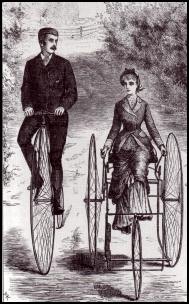
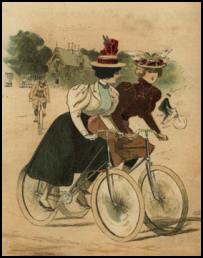
1880 - Amanda Bloomer promotes "rational dress" for cycling.
1881, March - Judge rules in favor of Franz and Pope against the Lamb Knitting machine company for patent infringement.
1881 - Crestline Advocate reports that Franz and Pope has shipped 127 "Steam" machines this season, and "orders not all filled". This would seem to mean that they are producing industrial machines at this point.
1882 - Tramps appear at house next door to F&P factory demanding the lady of the house prepare the steak they had in their possession.
1883 - Frances Willard President of Women's Christian Temperance Union.
1883 - Ida Mae Pope enters Oberlin College
1885-1890 Introduction of the "safety bicycle" led to the Bicycle Boom.
1887 - Ad in Crestline Advoice for 20 "girls" needed for employment
1888 - The Bucyrus Evening Telegraph reports that Franz and Pope are turning out black stockings
1889, February - The Evening Telegraph reports on a new patent that improves the efficiency of knitting heels and toes with less manual effort.
I interpret this to mean that prior to this innovation, the knitting was customarily made in a tube, removed from the machine, and then heels and toes were knitted in by hand, probably on four needles. I cannot yet determine whether the innovation mentioned here was the ability to knit back and forth with only some of the needles in work, (reciprocating cylinder) or whether it was the addition of a take-up spring to keep tension on the yarn being fed into the machine.
1889, July - Miss Kate Kelly was reported as travelling to Philadelphia to perform training there.
The website Emerging Civil War (link here) describes the dangers and difficulties of women travelling alone during the 1800's. First, think of the clothing and baggage they would have to wear and handle and keep track of during their trip. Hoop skirts, corsets, crinolines, and so on. They most likely travelled by rail, since the Federal Highway System was still decades in the future and cars weren't common. Roads were in terrible condition. Airplanes had not been invented. A missed train would result in having to make on-the-fly travel arrangements for eating and sleeping, with no google maps app to help find hotels. "The combination of the Civil War and railroad travel gave a woman a level of slightly greater autonomy, allowing her to journey from her home and local community into the wider world beyond with or without a man’s protection. However, the difficulties and dangers of traveling remained, testing and shaping how ladies traveled in war-torn America. Ultimately, her travels and journeys during the Civil War influenced culture, creating a stronger, yet still feminine, image for American ladies that would play an important role in the saga of women, travel, and creating new cities in the West during the post-war years."
1889 , H. D. Lee moves from Galion, Ohio to Salinas, Kansas for his health on the advice of his doctor (he had tuberculosis) and founded the company that would become Lee Jeans.
1889, Christmas Day - Report in Evening Telegraph about the good year and improvements to the equipment
1890, February - Evening Telegraph reports sale of machines to knitting mill in Elkhart, Indiana
1890, February - Announced the issuance of preferred stock to enable hiring of 100 workers
1890, March - Announcement that J. R. Perrott, a forman of over 20 years experience, has been dismissed. There must be more to the story!
1890 - Ida Mae Pope leaves for Hawaii (A Light in the Queen's Garden)
1890, September - Report on the funeral of Dr. Pope in the Evening Telegraph
1891, March - Ad for black stockings
1891, June - Announcement that a superintendent has been hired, a Mr. J.G. Prosser
1891, August - Industrial accident involving hot oil and steam to an employee's face
1891, September - Report on an order from a company in Marion, Indiana
1891, October - Katy Kelly hired as bookkeeper
1891. Lois Pope, Dr. Pope's eldest daughter, married J. G. Prosser.
1891, October - Feature article on Bucyrus businesses includes an article mentioning both the industrial knitters and a drawing of Franz and Pope home use machine.
1892, January - Annual meeting to elect officers and directors is reported.
1892, July - Large order received for a new knitting mill in Bowling Green, Kentucky.
1892, September - Large order received for a new knitting mill in Bloomfield, IA
1892, December - The company entertained a Mr. Fettig from Michigan City, Indiana as he planned to relocate his knitting mill from there to Bucyrus. He was to take over the top floor of the Franz and Pope building, and was producing "Reform Underwear".
One of the first reform undergarments to be promoted in America was the “emancipation union under flannel” patented in 1868. This union suit combined a knit flannel waist (shirt) and drawers in one. The combination, as the union suit was often called, was continuously improved by various knitwear companies and reformers in America. Susan Taylor Converse of Woburn, Massachusetts, designed an improved version in 1875 and named it the Emancipation Suit. A gathered section across the bodice freed the breasts from compression, and sets of buttons at the waist and hips helped suspend several layers of skirts. The Emancipation Suit also could have been purchased as two separate parts that buttoned together at the hips. (Ohio State University)
The 1892 United States presidential election was the 27th quadrennial presidential election, held on Tuesday, November 8, 1892. In a rematch of the closely contested 1888 presidential election, former Democratic President Grover Cleveland defeated incumbent Republican President Benjamin Harrison.
1893, January - Report of Annual Meeting and election of directors. Henry Pope, Dr. Pope's son, is re-elected President of the company.
1893, February. Report of large sale to a new knitting mill in Meridian, Mississipi. Miss Kate Kelly to travel there for a period expected to be six weeks to supervise setup of operations.
1893, April. Henry Pope travels to Chicago and starts a knitting mill there.
1893, June. Shipping report detail includes a shipping report of Franz and Pope machinery to Hamburg, Germany
1893, December. Notice of annual meeting
In its impact on industry and employment, the depression of the 1890s was on a par with the Great Depression of the 1930s. In some places it began before 1890, in a deep agricultural crisis that hit Southern cotton-growing regions and the Great Plains in the late 1880s. The shock hit Wall Street and urban areas in 1893, as part of a massive worldwide economic crisis. A quarter of the nation's railroads went bankrupt; in some cities, unemployment among industrial workers exceeded 20 or even 25 percent.
1894, October. Report of sale of equipment to second penitentiary facility. The first was reported to be successful.
1890's - Knitting mills, such as the one pictured below in Western New York, often still used sewing machines to finish socks and stockings Source: Observer-Dispatch Utica NY
Here is an interior photo of the Amazon Knitting Mill in Muskegon, Michigan showing hundreds of Knitting machines
Photo courtesy of Heritage Museum in Muskegon.
1894, December. Notice of Franz and Pope annual meeting
1895, January. Report that an industrial accident occurred. Frank Greenich, 17 years old, was polishing a cam when the machinery exploded, crushing his skull. The injury was fatal.
1895, January. Queen's followers in Sandwich Islands (now Hawaii) post a rebellion which was quickly put down. Ida Mae Pope was a witness to these historical events, as she was teaching in a school for royal children there. J. R. Perrott (former F&P superintendent) and Mrs. Clymer received the Sandwich Island papers in Bucyrus, and report that all the Bucyrus contingent in the Islands are all right.
1895 - Frances Willard publishes "A wheel within a wheel - How I learned to Ride a Bicycle"
1895, April. The bicycle craze was upon the nation, and the Evening Telegraph reported on the trend by publishing many items about bicycles and wheels. One of the wheels was on display at the Franz and Pope locations.
1895 Rational dress has been promoted for several decades, finally tailor-made cycling outfits find acceptance.
1895, May. Franz and Pope had a company baseball team, and they publicly challenged the team of another company,
1895, December. Franz and Pope facilities were closed by the sherriff to satisfy company debts as was ordered by a judge in Upper Sandusky. The company was expected to reorganize, satisfy debts, and continue operations. A large order for machines was received the same day.
1895, December. A receiver was appointed to reopen the company and process outstanding orders.
1896, there was simultaneously an increase in bicycle popularity and a severe economic depression. Bicycles were one of the few areas of the economy where sales were growing; people were buying bicycles "whether they could afford them or not". This attracted hundreds of manufacturers into the bicycle business. This increase in production resulted in a downward spiral of market saturation, over-supply and intense price competition. Many bicycle manufacturers, faced with excess inventory and prices too low to make a profit, went out of business. (Wikipedia "bicycle boom")
1897, March. The stockholders re-organized the company and re-initiated operations of the reorganized company.
1897, May. Report of the stockholder approval of the sale.
1898, May. The fifth annual Ohio Women Suffrage Convention takes place in Akron. Speakers include Susan B. Anthony, Anna Howard Shaw and Zerelda G. Wallace.
1900- U.S. Census report reports on manufacture of needles and pins and latch-hook knitting machine needles.
1903 - Model T Introduction by Henry Ford. Orville and Wilbur Wright fly at Kitty Hawk.
1903 - Lois Pope-Prosser and her husband, Joseph George Prosser, moved to Kankakee, Illinois to join the rest of the family. J.G. went into business with her brother Henry. (Source: A Light in the Queen's Garden, p. 282)
1913, February. Report of the completion of an addition to the building.
1914, January. Henry Pope, formerly the President of the company, and now living in Chicago and operating a successful knitting mill with over 1000 employees, visits Bucyrus with his son. They stopped by the TWO locations of Franz and Pope. One was on Lane Street and was being demolished. The other building was on Carroll. He found two medals from the Centennial Exhibition and took them as souvenirs.
1914, July. Obituary for Ida Mae Pope. The daughter of Dr. William Pope, the company founder, she became a missionary in Hawaii. The obituary reports that the surviving descendants of Dr. Pope are now all living in Chicago. Note: Ida Mae Pope is the subject of the book by Sandra Bonura "A Light in the Queen's Garden". The first chapter of this book mentions the Franz and Pope knitting machine company. The rest of the book details Ida's education, which was enabled through the patent infringement lawsuit settlements, and her missionary work in Hawaii with schools for Hawaii's tradiitonal royal children.
1916, February. Obituary for Almira "Myra" Franz. She was the wife of William Franz. Since he was a leading citizen of Bucyrus, there was biographical information about him in her obituary.
1917, November. World War I-era article describing the quantity of socks knitted for the local Red Cross by the Bucyrus chapter. The group used Franz and Pope knitting machines to achieve their large quantities and the article mentioned "that they have come into popularity again".
1917, December. Another article describing an additional quantity of socks knitted by the Red Cross Chapter using the Franz and Pope machine.
1919. Ohio ratifies the 19th amendment giving women the right to vote.
1922. Connection between Henry Pope and FDR, bonding over polio recovery. See below.
1922. An important needle-production innovation occurs: punched massive needles are introduced. Source- Groz-Beckert
1925, January. Death of Dr. Pope's son "Biddy" who was a newspaperman. Two front-page columns given to history of the Crestline street layout and occupants, including Franz and Pope's original jewelry store location. The article also mentions William Franz's career and his ancestors. He was born in Leesville, just northwest of Crestline, and educated in Bucyrus. His father was Crawford County Sherriff.
1938. The federal child labor provisions, authorized by the Fair Labor Standards Act of 1938 (FLSA), also known as the child labor laws, were enacted to ensure that when young people work, the work is safe and does not jeopardize their health, well-being or educational opportunities.
1938. Invention of nylon, which has since been used in sock wool to promote longer wear.
1970, December - President Nixon signs the Occupational Safety and Health Act on December 29, 1970, which was enacted on April 28, 1971. In its first half century, OSHA has helped transform America's workplaces in ways that have significantly reduced workplace fatalities, injuries, and illnesses.
I was curious about the knitting company in Chicago started by the family of Dr. Pope. I found this obituary for his grandson, Henry Jr. on the website of the Chicago Tribune.
Mr. Pope also was president of Paramount Textile Machinery Co. as well as vice president of Neumode Hosiery Co., which had hosiery outlets throughout the Chicago area."