. brightmeadowknits

Wednesday, February 16, 2022

Stripes are fun. Maybe.

 I'm making another sweater using substantially the same design as the last one.  Except that I am using a different yarn, yielding a different gauge.  The gauge dictates 232 stitches for the front.  Since my standard-gauge machine has 200 needles, that's impossible.  So I decided to make a center front and a center back seam.  

The DOMY yarn I am using is from an auction (see previous post).  There is not enough of one color to make the entire sweater.   So I decided to use stripes. 

After knitting a short while, I decided it would be best to install a color changer.  I have several, which I accumulated with used machines.  

I have only ever actually used one of them, and it was a long time ago.  

I am knitting on the single bed (except of course for the ribbing) so I decided to use the 720A color changer.  

It is actually working quite well. 

Except when the yarn breaks and the entire sweater falls off the bed of the knitting machine.  

I've been working on this for forever, it seems.  I've finished one half of the front and am halfway through the second half. 

I decided to take a break and work on a commission.  A friend of a friend wants a red beret or tam.  I knitted one based on Diana Sullivan's Tam Take 2 pattern, only I knitted with a lining due to our cold Ohio winters.  I tried it on. (don't worry, I'll steam it again before sending it out.)   It looks pretty good.  Especially with the French marinière, or Breton-style sailor's top. 


I missed a couple of stitches, evidently, hanging the ribbing onto the body of the hat, because it didn't quite come out even at the center of the pinwheel.  But almost!   Barely noticeable!  I'm not going to fix it, as I spent the better part of a day completing it.  And I am not charging enough to cover my labor at minimum wage already.  I knitted this in acrylic from my stash.  


I am thinking I should make one for myself now that I've had some practice.  

After I get back from grocery shopping, it's back to the grindstone for the striped sweater. 


Tuesday, February 8, 2022

Midnight Revelation

Domy = DOMY = Davidson's Old Mill Yarn


That is all.  

Monday, February 7, 2022

Domy Yarn

 Update on the Domy sweater.  This yarn was from Davidson's Old Mill, according to the label, and I purchased it in a box lot in an auction.  I loved the texture of the yarn.  

I recently knitted a sweater from yarn I had spun at Zeilinger's.  I took this pattern and tweaked it a little, giving it a little more ease, entering in the gauge from my Domy swatch, and lengthening the sleeves by one and a half inches. 

Yesterday I weighed my swatch.  I entered the number of stitches in the swatch (40 stitches, plus 5 stitches each side, for 50 stitches, times 72 rows.  (The part of the swatch that I measure is 40 stitches by 70 rows, but for the total weight, I have to measure the "extra" stitches).  

I entered the swatch weight and number of stitches in Garment Designer. I pressed "Generate yarn calculations" and, lo and behold, GD calculated the theoretical weight of each piece. 


Then I took the piece weights and entered them into an Excel Spreadsheet to total them.  Adding them all up, and entering the weight of the yarn balls I have,  it seems that I will have enough yarn to complete my sweater! 


But, how to distribute it my yarn evenly? I plan to make the bands solid grey and stripe the body pieces.  By calculating the ratio of the yarn I have, I was able to determine that I need to have a 2:1 proportion in the body.  I decided to use four rows of gray to every two rows of lavender.  Well, actually, it might be called Amethyst.  It's awfully close, the amount of yarn I am calculating I will need to the amount I have.  I may be playing "yarn chicken" by the time I get to the last piece.  

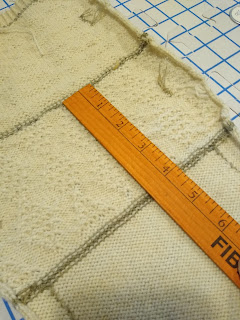
There will be six pieces to sew together.  My machine does not have enough needles at this gauge to join the two sides of the front and back, so my garment will have seams.  The stripes should make it easy to mattress stitch neatly.   I realize there are other techniques I could use, such as tuck or rib, to make a wider fabric, but those also result in a thicker fabric, and I would not have enough yarn to complete the project.  

I read an article online about Old Mill Yarns in the Lansing State Journal.  It was interesting to learn that the original owners' family ran the business for 100 years.  Today I called the new owners to find out more about Domy.  They have purchased the business from the original owners in Eaton Rapids and are now open in Allegan, Michigan.  The woman I talked to explained that the Domy yarn was actually mill ends of Jaggerspun Domy Heather.  Old Mill has discontinued the yarn.  Jaggerspun has also stopped spinning yarn.  She had 3 skeins of "cranberry" in stock, but that is all there is of the Old Mill Domy.  A Google search revealed that Webs online yarn store still has Jaggerspun yarn in stock, but maybe not this particular weight.   I ordered the cranberry.  Just compounding my problem, as now I will not have enough to do anything with the cranberry yarn.....   

I wondered what the name "Domy" referred to, but I did not find any answers.  

I procrastinated a lot today.  I think I have a fear of succeeding at making this sweater.  I didn't want to get started.  Finally, after we returned from dinner and my husband went to bed, I started knitting. 

Changing the yarn in the feeder every four rows is kind of a pain.  I have two color changers but I have never used either one of them.  I fiddled around trying to set up one of them but determined at the end it was for double bed work.  I am not sure if either of my color changes will work on a single bed.   Something else to research. 


Onward and upward

 I finished a thing! 

The sweater I wrote about a few posts ago, the one with sock yarn, is finished.   It had a few false starts, as I knit the front shorter than the back the first time.  

I designed the pattern using Garment Designer. I have narrow shoulders compared to my thick abdomen, and I believe that is why I often have trouble with commercial patterns.  The shoulders on them are usually too wide.   I don't like the drop sleeve shoulders, since there is too much fabric draping and bunching around the underarm.   So I chose a set-in sleeve.  


What do I like about this project? 

1.  It is a classic style.  

2.The yarn is soft.  

3. It is a lightweight sweater that is perfect for snowy days. 

4.  The neutral color will coordinate with anything.  

5. I made it from yarn that I initially purchased as raw wool.  

What mistakes did I make?

 1. I initially knitted the front too short.  I discovered this after I knitted the back and compared the back to the front.  What happened?  I believe I deducted the bottom ribbed band from the total rows to knit, when they should have been included.   When I decided to make the front again, I was able to use the yarn from the first front to knit the first sleeve and part of the second. 

2. I am not sure why the set-in sleeve cap seemed too short to ease into the armhole.  It seemed like the underarm was shorter on the sleeve than on the garment.  But if the sleeve underarm had been wider, the entire sleeve would also be wider.  I did not mark the points to sew together.  

3. I had some trouble with the ribbing for the neckband.  The long section, which was one side of the front plus the back, was no trouble.  The short section gave me fits.  I knitted it four times.  There was a needle on the main bed, number 5, which was inconsistently not knitting.  After the first two attempts, I changed out the needle.  Then the third time, the tension of the ribbing seemed mysteriously too big.  I had knitted with garment tension 10 and ribbing tension 8.  Thinking perhaps I had knitted the ribbing at tension 10, I unravelled and knitted it one more time. There didn't seem to be enough weight on the piece, so I pulled it down with my left hand while moving the carriage to the right.  When taking it off, I realized it was also too loose.   It was after 11 pm, and I decided to put it on the garment anyway, hoping that blocking would make the slight difference go away.  

4. When I initally washed the sweater to prepare for blocking, I used the "handwash" cycle with Ecos detergent.  As it was lying flat to dry, I noticed a dark line on the front at the bottom of the V neck where I had taken half the front off on waste yarn.  I wasn't sure if it was oil from the needles or lint from the dark green waste yarn I had used. I sprayed the line with De-Solve-It and put it back in the washer for a second cycle.  This time I used Persil detergent ande "delicates" cycle.  The sweater had significantly less moisture when I removed it.  I think there must be a longer spin cycle on the delicates cycle.  It seemed like there might have been a little shrinkage, which I did not notice the first time.  The good news is the line is gone! 

What would I do differently next time? 

1. Determine the issue with the set-in sleeve if using this style again.  Maybe print the pattern and tissue-fit or make a muslin from some commercial fabric. 

2. Indulge my inner perfectionist and make that ribbing a fifth time. 

3. Send the swatches through a "delicate" washer cycle instead of just washing by hand. 

4.  Stop knitting before 10 pm.  I make bad decisions when I am tired. 

5.  Perhaps add some embellishment in the form a a wider fully-fashioned seam for the armholes.

Next project:

I have so many projects going on, it's hard to choose.  

I purchased some items at auction which included some weaving yarns and sewing supplies.  Also to my surprise, at the bottom of a bin,  were some lovely crocheted tablecloths, placemats, and dresser scarves.  It is sad to me to see these items which represent hundreds or perhaps thousands of hours of effort valued so little.  I am celebrating my acquistion by proudly displaying the large tablecloth on my dining room table. 


 In the same auction lot was some very nice wool yarn.  The labels appear to be of varying age.  They say "Davidson's Old Mill Yarn, Eaton Rapids, Michigan".  I have visited that place many years ago, and in fact some of my overflowing yarn stash was found in the large Gaylord boxes in the middle of their warehouse.  But this yarn apparently was actually spun for or by them.  This company has moved to Allegan, Michigan, where the Michigan Fiber Fest is held annually,  and has changed owners.   The older, yellowed labels have DOMY hand-written on them along with 490 yards/100 gms. The newer, brighter white labels have the same information printed, and say 475 yards per 100 gms.  There were four skeins, two grey and two amethyst, and one ball of grey.  I wound them into cakes.  There were several breaks in the yarn, perhaps due to insect damage, but I saw no other evidence of pests.  I tied the broken ends together. 


The yarn is a beautiful heather color.  I knitted a swatch.  40 stitches by 60 rows = 5.5 inches, or 7.27 st. and 10.9 rows per inch at T7.  


There is a broken end with knot in this swatch, and you can't even see it!  I am not sure how I will approach the broken ends.  I am concerned I may not have enough for a long-sleeved plus-size sweater.  So I checked Ravelry for projects using this yarn.  I found 582 matches for the yarn in the Projects category.  This surprised me!  And opening up some of the projects, I found a few people raving about how this was their favorite yarn.  The projects I looked at, long-sleeved sweaters, ranged from 2 skeins to 12 skeins.  The 12-skein project won a prize at the Minnesota State Fair!  


It was a size 42" and I am a size 48".   I have 5 skeins. I will have to supplement with a similar yarn.  Hopefully I already have some of a similar weight in my stash.  I am thinking of making a fairisle pullover.  I'd like to make a yoked sweater, but I haven't found a pattern to match my gauge in my size yet, alhough I spent several hours looking yesterday.  I have both Design-A-Knit and Garment Designer, and although I can probably achieve a yoked garment with a lot of manual adjustmentes in both of them, neither of them has a yoked design "out of the box".  
More to come.  

Saturday, January 15, 2022

Finally....learning how to crochet

 I never thought I would ever learn how to crochet. It's like a mental block for me. Every time I open up a pattern and look at the instructions for half double, treble, single, or double crochet stitches all together in one row, I freeze. I can't seem to remember why a single crochet is NOT THE SAME as a half double crochet. And then when it starts talking about making shells? No way.  

Last year I started making a big hamper, though, using worsted weight yarn. It's only one stitch pattern. A single crochet. Over and over. I must have made ten thousand stitches by now. It's a good mindless project to do while watching TV with my husband. I started without a pattern, and, as was probably to be expected, it's pretty floppy. My vision was to have a big hamper or basket to pile afghans in. I'm not sure if I'll ever get done with it. I still have to work out how to make handles. But my main goal was to learn the single crochet stitch, and I have succeeded in that.


And (drum roll, please....) today I learned to do a half double crochet stitch!


This scarf is only made up of foundation and turning chains and the half double crochet stitch.  I think this is the best way for me to learn, by reposition, until muscle memory takes over and I have learned the stitch. 

I got a full row about six feet long done in the class, and I have gotten a little faster and done a few more rows since I got home. The yarn is a bulky weight and I am using a size 6 (European?) hook. The pattern actually called for a larger hook.  

Actually, the pattern called for a size N, but I thought we were supposed to use a size K, which I do not have in my collection. 


 Isn't it nuts for someone who doesn't know how to crochet to have so many crochet hooks?  I've acquired many of them along with sets of second-hand knitting needles.

Maybe in 2023 I'll attempt the double crochet stitch!

I had not visited Alpaca Meadows before.   Right now their hours are limited to Saturday afternoons, and other days by appointment.   I was amazed at the beautiful variety of alpaca yarns, accessories and alpaca-themed gifts they had in stock.   I'll definitely be back.  Even after the second half of the class which is in two weeks.


I had no idea we had this resource in our community.  So even though we don't have a LYS on Main Street any more, between Alpaca Meadows and the Fiber Arts Guild at Malabar Farms where handspinners sometimes offer beautiful handspun yarn, a knitter will never be out of yarn here.


Wednesday, January 12, 2022

Biking, touring, and Knitting?

Are you a knitter? Are you an easygoing touring cyclist willing to pedal from 30-50 miles a day, camp in a tent sometimes, and sleep in a bed-and-breakfast other times? 

I'm planning a two-week tour of Ohio and Indiana local knitting shops, alpaca farms, and sheep farms as well as other fiber-y places.  I also anticipate stopping at locally-owned restaurants for lunch and dinner, as well as local bike shops for necessities.  


I'm still working out the details.  I know I won't be taking along a knitting machine or a spinning wheel, but maybe a pair of needles would fit in my pannier.  I anticipate buying some yarn along the way, and I am assuming they will ship it to me! 

This trip was inspired by Knit 1, Bike 1, a book by Janet Renouf-Miller, the story of a "woman of a certain age" who cycled across Scotland visiting local knit shops.  Along the way, she crocheted some of the things she saw, she kept her fans updated, and she made a voyage of self-discovery. 

I, too, have been discovering what I can do now that I have retired.  I never thought of myself as an athlete, but over the course of the last two years I have pushed myself to ride further than I ever thought possible.  All it took was the BELIEF that I could do it.  

I am looking at dates for this tour.  Someone suggested I should leave from the Great Lakes Fiber Expo in Wooster Ohio over the Memorial Day weekend.  That might get me back just in time to leave for the Pedal Across Lower Michigan in late June.  

I think I am maybe not the only one who would like to do this.  I just read an article in Adventure Cycling from 2012 where a whole knitting club took a bike trip to the Cour d 'Alenes in Idaho. 


Saturday, January 1, 2022

Adventures in Sock Yarn

 I don't remember if I posted about the "free" yarn I got on Craiglist, several years ago.  My daughter called me and told me that I should check it out.  The listing said, "we just moved in, there is something in the barn, we think it might be wool, if you want it you can have it."  So I went and picked it up with my husband's truck. It was, indeed, sheep's wool.  I took it home and unloaded it.  Unrolled the sheets and looked at it.  It looked like a lot of work.  The fleeces needed to be unrolled, skirted, picked, washed, carded, and spun in order to get some yarn out of it. 

I thought about how I would accomplish all that work for a few weeks.  Then I drove to Michigan to the Zeilinger Woolen Mill and inquired if they would be able to process it.  It turned out that I had just enough wool to meet their minimum quantity for processing, and they would be happy to perform all those services for me.  

So, I had them make some sock yarn and some DK yarn, and leave some at the roving stage for me to spin. I don't remember the exact number of cones I received.  It was either about 50 of each, or 100 of each.  Probably 50. 


The yarn feels a little rough on the cone, but once it is knitted and washed, it is delightfully soft and fluffy.  I spoke with a fiber person in Michigan later, and she mentioned that she did not like the smell of the spinning oil that Zeilinger's uses.  I hadn't noticed it previously, but now I do.  It does wash out and is not noticeable in the finished garment. 

I've moved these cones from Ohio to Michigan and back, and I recently decided it was time to use some of it.  I have previously dyed some of the DK yarn for sweaters,although I haven't knitted the sweaters yet,  and I have made four pairs of socks from the sock yarn.   I love the socks, but I have way more sock yarn than I will be able to use up on socks.  So I decided to knit a sweater with the sock yarn, 

The yarn is a little bit heavier than  commercial sock yarn. It does go through my circular sock machine well, but I wasn't sure how the flat-bed knitting machines would handle it.  So I started swatching.  I know that being plus-sized, it would be to my advantage to get the widest possible fabric for the number of needles, so I picked a built-in tuck stitch to swatch.  I ended up choosing stitch pattern 229. 

I swatched in stockinette, in tuck, then I used a variation that Mary Ann Oger had mentioned in the last seminar I attended with her. This is to turn on the double-high key and tuck in only one direction.  The technique produces a flatter fabric with a less bulky tuck design. She says it looks less like a baby blanket that way. 

My first swatch was on a KH-930 standard gauge at tension 8.  I cast on a few stitches on either side of 21 and marked the tension with 8 eyelets.  Then knitted a couple of rows of contrasting yarn (I used acrylic because I have a lot of it.)  It was super hard pushing the carriage across the bed.  The resulting swatch seems a little stiff.  But I was surprised that the stitch tension swatch with only every other row tucked was almost as wide as the tuck sample! 


I washed the swatch in warm soapy water and wet-blocked it.  After it was dry, I removed it and I knew I would not like a sweater at this gauge. 

Since that tension was so tight, I thought that perhaps the yarn would do better on a bulky machine. I tried the bulky KX-260 punchcard machine.  I set the machine for tension 1. I cast on a 20x30 swatch with a few stitches on either side.  The yarn fed easily through the machine, but the resulting fabric seemed a little bit lightweight.  Just for comparison, I went ahead and continued to make another swatch at tension 2.  I was worried about how I would achieve a ribbing at a tighter tension on this machine, since the stitch size tension was already at 1 and 2, and not possible to set any lower.  I didn't think this fabric would work, so I didn't bother digging out a tuck punchcard.   I went ahead and washed and blocked the swatches anyway.  

Meanwhile, I decided to have another attempt on the KH-930 standard gauge machine.  I still had tension 9 and 10 as a possibility.  I did make stockinette, tuck, and half-tuck in each stitch size for this swatch.  You might note that I carry my marker yarn up several rows.  This helps me with keeping the stitches aligned while blocking. I'm not all that excited about the half-tuck pattern.  I am thinking I may just make this sweater in stockinette.  A simple, classic V-neck sweater. 


Final swatch was on the mid-gauge KX-350.  I decided to only do stockinette, since the KX-350 does not have built-in patterning.  My KX-350 is in rough shape.  The last time I used it on worsted-weight yarn I really had a hard time pushing the carriage across.  I turned the carriage over and I saw a lot of gouges in the plastic guides.  So I filed them down a little using sharp scissors and an emory board, lubed the machine, then proceeded to make my swatches.   I used tensions 1 through 4.  I hand-latched up the ribbing.  After washing and blocking this swatch, I like the "hand" of tensions 1 and 2.  I like tension 1 best. 


The carriage pushed a lot easier than the KH-930.  


Next, I measured the height and width of each of the swatches, between the marking threads.  


I entered all these measurements in a spreadsheet.  Listen to my comments by clicking the arrow in the display below.


I'm also hand-knitting a cowl with some yarn I acquired a few years ago at Heritage Spinning and Weaving in their clearance sale.  The yarn is mostly silk.  It's from "Delicious yarn"  and the pattern is "Gourmet Cowl"  The yarn is so soft, it is like a cloud.  There are pictures of it on their Facebook page, and you can also find it on Ravelry or Etsy.  You can google for "Delicious yarn gourmet cowl images" to see it.  Unfortunately I can't post a photo directly unless I take my own photo, and my cowl is only a few inches tall at this point!   It is definitely a project for a yarn snob as this yarn is just luscious! 


 It has been a frustrating pattern for me to knit, because I started knitting on a car trip.  I missed an instruction to knit one stitch on the first few rounds, so my rounds were not coming out right.  I think after about row 10 I finally got it right.  The cowl is knit on circular needles, but after each row there is a wrap and turn, so it is actually knit back and forth, but in a circle. I loved the look of the cowl, and I love the yarn.  I am just finding hand-knitting it too slow.  I don't mind hand-knitting on a car trip, but I don't like it at home with all these machines available. 

My brain is on fire with ideas about how I could knit this pattern on the machine.  I attempted it on my bulky with two acrylic yarns.   It isn't happening.  It would require the intarsia carriage plus the ribber, and I don't think they are compatible.  Then this morning, I got a brainstorm.  What if I turned it 90 degrees?  I could use the garter bar to flip the fabric every so many rows, and knit it on the diagonal.  I abandoned my half-started sweater on the 930, and picked some fuzzy acrylic yarn in my stash to see if I can make it work.   Instead of switching from knit to purl every 8 rows, I am doing it every 20 rows.  I will write the pattern up once I get it completed.  If it turns out!  It will not be identical, it will be similar. 


I just received two used machines (which is why we took the long car trip.)  I will be checking them out to see if all the parts are there and what kind of condition they are in, then will use them either for lessons or for sale.   I had been bidding on some auction machines and lost the bidding war, so when these two became available I jumped on the chance!  

My dear husband is currently trying to repair my KH-970.  The control box is not working.  It would appear to work until I plugged the control box into the knitting machine.  Then it would start a rapid ticking noise (my husband says it is "motorboating", for the technical term.) and the coffee cup would display.  After a time, the menu would come up.  I tried to load a pattern and knit, but the needles were not selected properly, and then the motorboating started again.  On the Facebook 970 group, someone mentioned to replace the battery.  Since the backlight for the LCD display has not worked for many  Checking the parts catalog I found that the replacement battery was a Lithium CR-2032, a common 3-volt coin cell battery. 

When I opened it and replaced the battery and the backlight, closed it back up, the symptoms did not improve.  However, the backlight was working again.  My husband has taken this as a challenge.  We got out his digital multimeter and ran through the tests in the service manual that were possible to perform. Everything was supposedly working.  He suspects it is a cold solder joint that needs to be re-soldered.  He started doing this last night and blew the fuse on the board.  We ordered a replacement fuse.  A few minutes later he blew the fuse in the transformer.  So until we find a replacement transformer (Power supply) we will not be experimenting any more.  There is always the option of spending $600 to purchase a CB-2 from the Knit Knack shop. But as long as I have more than 5 working machines, I am questioning why I would want to do that. 


© Bright Meadow Knits Blog · Privacy Policy · Terms of Use
© Bright Meadow Bicycle Blog · Privacy Policy · Terms of Use